Showing posts with label Soyeon Choi. Show all posts

Thursday, June 16, 2011

Ghost Images on the Sketch Pad


CCAHA Senior Conservator Soyeon Choi examines
charcoal sketch pad.

Some of my father’s best charcoal sketches are in a sketch pad that’s bound with a metal spiral binding along the top edge.  When you open the sketch pad, you see the original image on the bottom sheet and a reversed ghost image on the paper that’s been lying directly on top of it.

This can’t be good for long-term preservation.  Charcoal is a very attractive artistic medium, but its tendency to transfer and smudge makes it notoriously difficult to preserve.

Soyeon Choi, Senior Conservator at the Conservation Center for Art and Historic Artifacts, agrees that the current sketch pad situation is not healthy.  Fortunately, the artwork itself has survived its 60+ year history in relatively good shape.  The transfer has been direct, with seemingly little smudging on the original drawings.

Soyeon recommends disbinding the sketchpad and saving each individual piece.  She works the spiral binding to determine how to pry each of the little circlets open.  This one is a little tricky so she adds, “If it’s a problem, just cut the binding right down the top.  Then carefully pry it open and delicately remove the paper.”

Soyeon suggests putting each of the sketches in a mat.  (“Eight ply mat would be beautiful;  four ply would be okay.”)  The object is to avoid that paper-on-paper contact that caused the ghosting.  The mat will protect the artwork from further transfer and smudging.  The mats can be either stored in acid-free boxes or framed and displayed. 
“Store them or display them.  They will look great,” Soyeon assures me.

Special thanks to Soyeon Choi for her consultations during the past two weeks!


Original charcoal portrait by Art Price and the ghost of
its image on the adjacent paper surface.

© 2011 Lee Price

Monday, June 13, 2011

Bug Nests, Spiders, and Silverfish


The bug nest!

I don’t know where my parents stored the rolled nudes while I was growing up.  I have a feeling they were kept discreetly out of sight of curious children (that would be me and my sister) and their friends.  Wherever they were stored (basement, garage, or under bed), I’m afraid they suffered some indignities.

As Soyeon Choi, Senior Conservator at the Conservation Center for Art and Historic Artifacts, unrolled the first of the oversized artworks, she exclaimed, “Oh, a bug nest!”  Quickly, she used a natural rubber sponge to delicately brush off the little nest of cobwebs.  I asked her if there were any signs of active pest infestation and she said no.  These cobwebs could easily be decades old.

Later while unrolling more of the pieces at home, I discovered more cobwebs, as well as a few dead spiders and silverfish, buried within the rolls of artwork.  Fortunately, the pests appear to have done little damage to the paper.

CCAHA Senior Conservator Soyeon Choi
examining an oversized charcoal work
on paper.
But while these individual pests may be responsible for only minor damage, the rolled nudes as a whole could really benefit from a little loving care.  According to Soyeon, they exhibit surface dirt, foxing, acidic tape mends, and tears.  However, Soyeon assured me that a good paper conservator can address all these problems and make them look nearly as good as new.  Six decades of neglect can be largely reversed if the problems are properly and professionally addressed.

© 2011 Lee Price

Wednesday, June 8, 2011

Introduction to Friable Media

CCAHA Senior Conservator Soyeon Choi unrolls a
rolled charcoal sketch.

Both of my parents liked to work in charcoal.  My father filled several notebooks with his charcoal sketches and my mother worked frequently in charcoal, including the 50 rolled nude drawings that she drew while attending Traphagen School of Fashion.  Preservation of these charcoal pieces poses a considerable challenge, largely for the simple reason that charcoal smudges so easily.

In the language of conservation, charcoal is a friable medium.  This means it has a tendency to crumble, detaching from its original surface and easily transferring to another.  Place a clean sheet of paper over a charcoal drawing and some charcoal will invariably rub off onto the clean surface.

The decision to roll up my mother’s charcoal nudes was an unfortunate one.  With the scrolling, the paper became in constant contact with it reverse side (the “verso”) and any jostling in storage increased the rate of transfer.  Soyeon Choi, Senior Conservator at the Conservation Center for Art and Historic Artifacts, recommends that I invest in a new storage strategy for the rolled nudes.  Ideally, she says, I should have each sheet of paper humidified, flattened, and matted, and then store them flat.  Unfortunately, the expense rules out this option for me, at least for now.

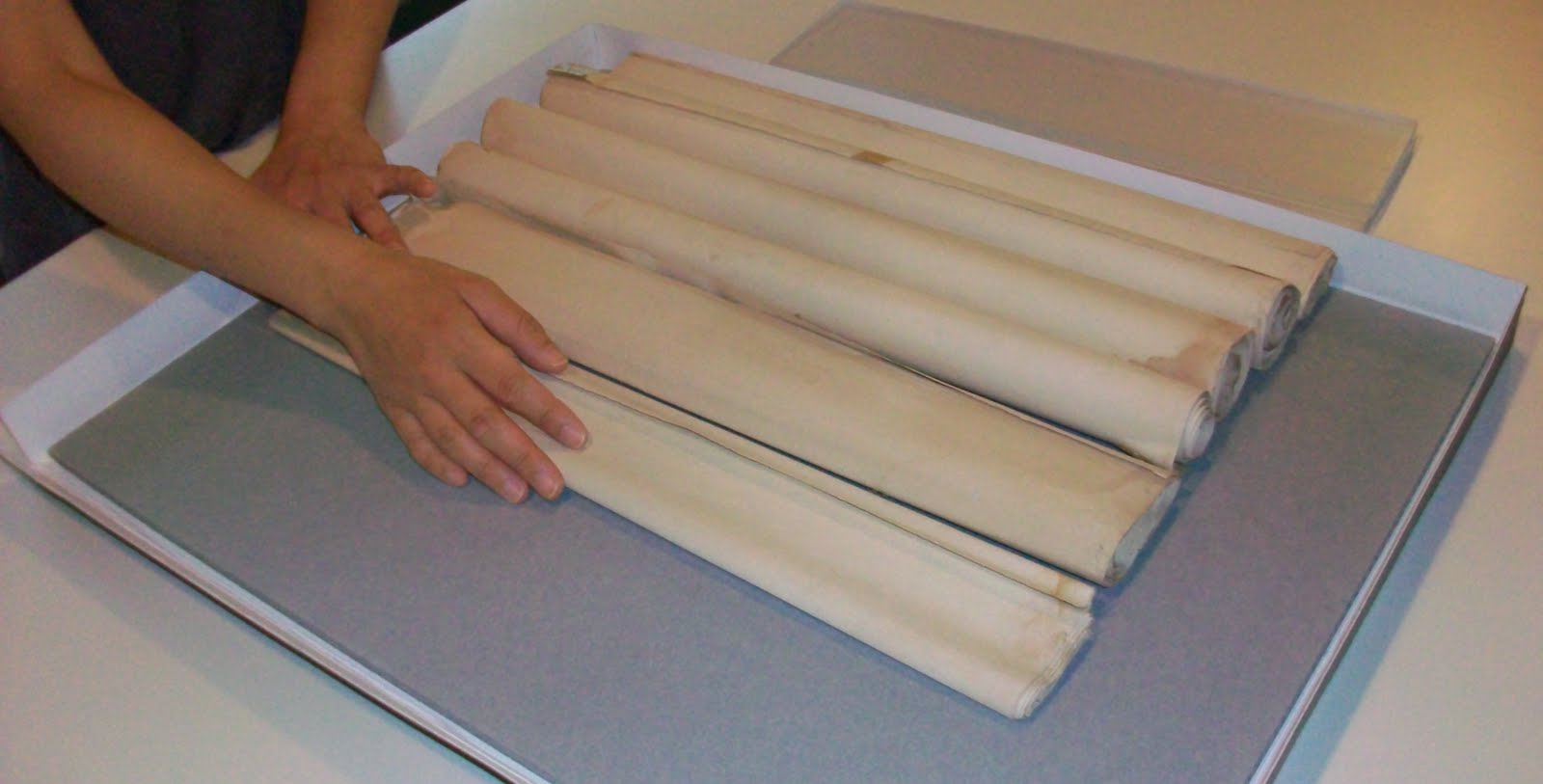
So Soyeon suggests a second option, not as ideal as storing them flat but better than returning them to the plastic trash bag that has accommodated them for many years.  “You can get a good acid-free box – ideally custom-sized so they don’t shift around – from a respected supplier like University Products or Gaylord.  Place the scrolled papers inside the box to create a single layer along the bottom.  You can probably comfortably fit around ten into a single box.”  She emphasizes that there should be no weight from the top.  “They’ve been squashed enough.  You can keep them rolled and safe in a box until you’re ready to upgrade to an even better approach.”


Rolled paper placed in a single layer in acid-free box.  Ideally,
boxes can be purchased that are custom-sized to fit the paper
length, preventing unnecessary jostling.

© 2011 Lee Price

Monday, June 6, 2011

Damage from Improper Storage

CCAHA Senior Conservator Soyeon Choi examining a
charcoal sketch on oversized rolled paper.

Back in 1949, my mother drew approximately 50 charcoal sketches of nude models for one of her fashion school classes.  The sketches were done on oversized flat paper.  At some point, these pieces were rolled up like scrolls for easy storage.  Then, perhaps a decade or two later, these rolled papers were shoved into a too-small plastic trash bag, crushing and deforming the artwork to an even greater degree.

I brought six of these rolled nudes into the Conservation Center for Art and Historic Artifacts for professional examination by Senior Conservator Soyeon Choi.  Soyeon and I carefully unrolled the first of them on the accession table.  She used heavy transparent acrylic blocks to hold the paper down, preventing it from scrolling back up.

“This paper is significantly scalloped,” Soyeon said.  “It’s become very distorted from being stored like this.”  We looked at each of the six oversized pieces in turn.  Some have retained a neat tube shape while others were somewhat crushed in storage.  It was discouraging to see the damage.

I asked Soyeon if anything can be done to return these pieces to their original appearance.  “To a great degree, yes,” she said.  “We could remove much of this distortion by humidification and flattening.  We would use the vapor chamber for the humidification.  I think we could make them look very nice.”

But I expressed my concern that it would be expensive to have 50 oversized pieces treated in the lab – more than we could afford.  Soyeon thought about this, then reasonably suggested:  “I would recommend picking your favorite for a full treatment.  Then you can store the others and maybe treat some more in the future.”

© 2011 Lee Price

Friday, June 3, 2011

The Rolled Nudes

Charcoal sketch by June Anderson.

Cross-posted on June and Art.  Please note that this entry does contain charcoal sketches of nude figures.

Flashback:  Back in spring 1949, June took a course at Traphagen School of Fashion where she learned to draw the nude human body.  Women models posed fully nude.  Male models were drawn nude when depicted from the rear.  Frontal views of men featured discreet coverings.  The drawings were oversized and were probably rolled into cylinders for storage soon after they were drawn.  The course ended in late May;  June met Art that Memorial Day.

At some point, the rolled nudes were all stuffed into a large plastic bag.  They disappeared into long-term storage.  I first looked at them a year ago, pulling out several to see what they were.  I didn’t look at many because they were unwieldy and fragile.  There are approximately fifty of these rolled nudes in our family collection.

Last week, I brought six of the rolled nudes into the Conservation Center for Art and Historic Artifacts for examination and treatment recommendations by Senior Conservator Soyeon Choi.  I selected the six pieces randomly, sight unseen, and carried them to the Center in a black plastic trash bag.

Soyeon unrolled the oversized drawings, one by one.  She used heavy transparent acrylic blocks to hold down the edges, preventing them from scrolling back up.  For the first time, I could see the nudes clearly.  According to the grades on most of them, this is “A” work.


All charcoal sketches by June Anderson.
© 2011 Lee Price