Showing posts with label Humidification. Show all posts

Tuesday, August 9, 2011

A Fabric Study, Before and After

The treatments are finished!  This is the second in a 12-part series on selected conservation treatments of artwork and photographs.  "Preserving a Family Collection" concludes on August 31.

Detail of the fabric study by June Anderson.

Detail of the fabric study.
My mother did this study of four curtain fabrics while studying at Traphagen School of Fashion, 1948-1950.  She received a B+ on it, but frankly I think it looks like better than B+ work!

Marion Verborg, 2010-2011 N.E.A. Fellow at the Conservation Center for Art and Historic Artifacts, performed the beautiful conservation treatment on this piece.  She surface cleaned it, mended the separating paper, reduced a stain, reinforced the delaminated corners, humidified and flattened it.

With a piece like this, the conservator’s first concern is to ensure that the treatment will not cause
any damage to the actual artwork.  This
Detail of the fabric study.
particular study was done with a variety of color inks and watercolor.  Since much of a conservator’s work involves use of humidity, it’s imperative to first determine if the colors will run or bleed when moistened.  When inks are involved, each color needs to be tested.  Marion tested the blacks, greys, and greens on this piece, ensuring that it would be safe to move ahead with proposed treatments that included humidification and stain removal.  The testing showed no water sensitivity, meaning that everything could proceed as planned.

Originally, my mother had placed a piece of tissue paper over the artwork, attaching it to the top of the board with a paper clip.  Paper clips don’t age well
and can be nasty to paper, leaving dents and
stains.  In this case, the tracing paper took most of the rust stain, leaving only a small stain and dent near the top of the board.  Marion removed the paper clip and reduced the stain with a cotton swab and calcium-enriched deionized water.

Everything I give to the conservator gets returned.  When the treatment was completed, I received a beautiful fabric study (looks like new!) and a rusty paper clip safely removed to a plastic bag.  I’m not keeping the paper clip – the artwork is great but I attach no sentimental value to old paper clips.


Fabric study by June Anderson, before treatment.

Fabric study by June Anderson, after treatment.
© 2011 Lee Price

Monday, August 8, 2011

Letter and Envelope, Before and After


The treatments are done!

Ten months ago, I brought in over a dozen representative items from our family collection for conservation treatment at the Conservation Center for Art and Historic Artifacts.  Most of the work was completed months ago, but I’ve postponed picking them up until now – in part because I wanted these pieces to serve as a climax to this limited-duration blog.  For the next three weeks, we’ll be taking a close look at these items and discussing the work with the conservators who worked on them

First up is one of the courtship letters that my mother wrote to my father when she was going to fashion design school in Manhattan and he was working as a grocery store clerk in Southampton, Long Island.  The letter is from October 5, 1949.

As with all the “June and Art” letters, we found them folded in their original envelopes.  In preparing the June and Art blog, I removed the letters from the envelopes, unfolded them, and stored them in plastic sleeves kept in a three-ring binder.  For the Conservation Center accession, I brought in one of these sleeves, containing a single letter and an envelope with two stamps – one clearly affixed and one hanging onto a corner of the envelope.

Paper conservator
Marion Verborg.
When Marion Verborg, the 2010-2011 N.E.A. Fellow at the Conservation Center, began the treatment, she took care of that strange stamp first.  Closer examination of the situation revealed that the stamp must have fallen off another envelope and subsequently adhered to this one by its residual adhesive.  It didn’t really belong with this letter-envelope set at all.  Marion used a wet cotton swab to humidify the stamp which softens the adhesive making it possible to carefully separate the stamp from the envelope with a spatula.

The letter is beautifully flat now.  The original creases – 60 years in the making! – are barely visible anymore.  This result was achieved through humidification and flattening.  After testing the inks to make sure they wouldn’t bleed when exposed to humidity,
Marion placed the letter into a “Gore-Tex sandwich” composed of:

Gore-Tex
Pellon*
The Letter
Pellon
Gore-Tex

The Gore-Tex is sprayed with calcium-enriched deionized water on its felt-like face and the absorbed water smoothly humidifies the object (the letter, in this case).  After humidification, the object is quickly transferred into a flattening sandwich (Blotter, Pellon, The Letter, Pellon, Blotter) under Plexiglas and weights to restore the planarity (the original flatness of the paper).

Five days later, the result is a VERY flat letter, looking much like it would have when my mother wrote it in her Manhattan apartment 62 years ago.
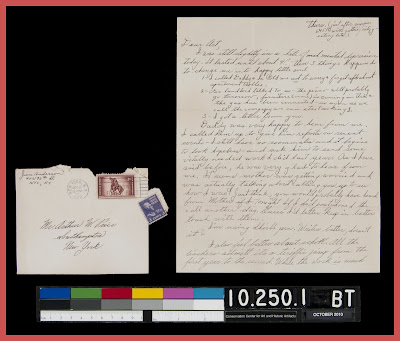

Letter and envelope, before treatment (BT).
Letter and envelope, after treatment (AT).

* Pellon:  Product name for a non-woven polyester web.

© 2011 Lee Price

Monday, June 6, 2011

Damage from Improper Storage

CCAHA Senior Conservator Soyeon Choi examining a
charcoal sketch on oversized rolled paper.

Back in 1949, my mother drew approximately 50 charcoal sketches of nude models for one of her fashion school classes.  The sketches were done on oversized flat paper.  At some point, these pieces were rolled up like scrolls for easy storage.  Then, perhaps a decade or two later, these rolled papers were shoved into a too-small plastic trash bag, crushing and deforming the artwork to an even greater degree.

I brought six of these rolled nudes into the Conservation Center for Art and Historic Artifacts for professional examination by Senior Conservator Soyeon Choi.  Soyeon and I carefully unrolled the first of them on the accession table.  She used heavy transparent acrylic blocks to hold the paper down, preventing it from scrolling back up.

“This paper is significantly scalloped,” Soyeon said.  “It’s become very distorted from being stored like this.”  We looked at each of the six oversized pieces in turn.  Some have retained a neat tube shape while others were somewhat crushed in storage.  It was discouraging to see the damage.

I asked Soyeon if anything can be done to return these pieces to their original appearance.  “To a great degree, yes,” she said.  “We could remove much of this distortion by humidification and flattening.  We would use the vapor chamber for the humidification.  I think we could make them look very nice.”

But I expressed my concern that it would be expensive to have 50 oversized pieces treated in the lab – more than we could afford.  Soyeon thought about this, then reasonably suggested:  “I would recommend picking your favorite for a full treatment.  Then you can store the others and maybe treat some more in the future.”

© 2011 Lee Price